Course Overview
Think tanks, nongovernmental organizations (NGOs), nonprofit organizations, foundations, and advocacy groups play an important role in shaping public policy at local, national, regional, and international levels. Through research, policy analysis, public campaigning, lobbying, community mobilization, and financial support, these organizations influence political debates, inform decisionmakers, and seek to advance particular social, economic, and political objectives.
Although these organizations often share similar goals and practices, they differ in their institutional structures, funding arrangements, ideological orientations, engagement methods, and relationships with governments and other political actors. Think tanks produce policy-oriented research and expertise; NGOs and community-based organizations address social needs, defend rights, and mobilize citizens; advocacy and lobbying groups seek to influence public decisions; and foundations provide financial or organizational support for initiatives intended to serve public or private philanthropic purposes.
This course examines the historical development, organizational structures, funding models, research practices, and policy-influence strategies of selected think tanks, NGOs, nonprofits, foundations, and advocacy organizations. Through comparative case studies from the United States, Europe, Russia, India, Latin America, and Africa, students will explore how these institutions operate within different political and institutional environments.
Particular attention will be given to the relationship between research and political decision-making, the role of ideology and financial interests, the transparency and accountability of non-governmental actors, and the opportunities and limitations of civil-society participation in policymaking. The course also investigates how these organizations contribute to, or sometimes complicate, the pursuit of democratic governance, human rights, political accountability, and effective public policy. By comparing institutions across different countries and regions, students will develop the analytical tools necessary to assess how non-state actors shape political agendas, influence public policy, and participate in contemporary national and global governance.

Course Schedule

During our classes we will study the following institutions:
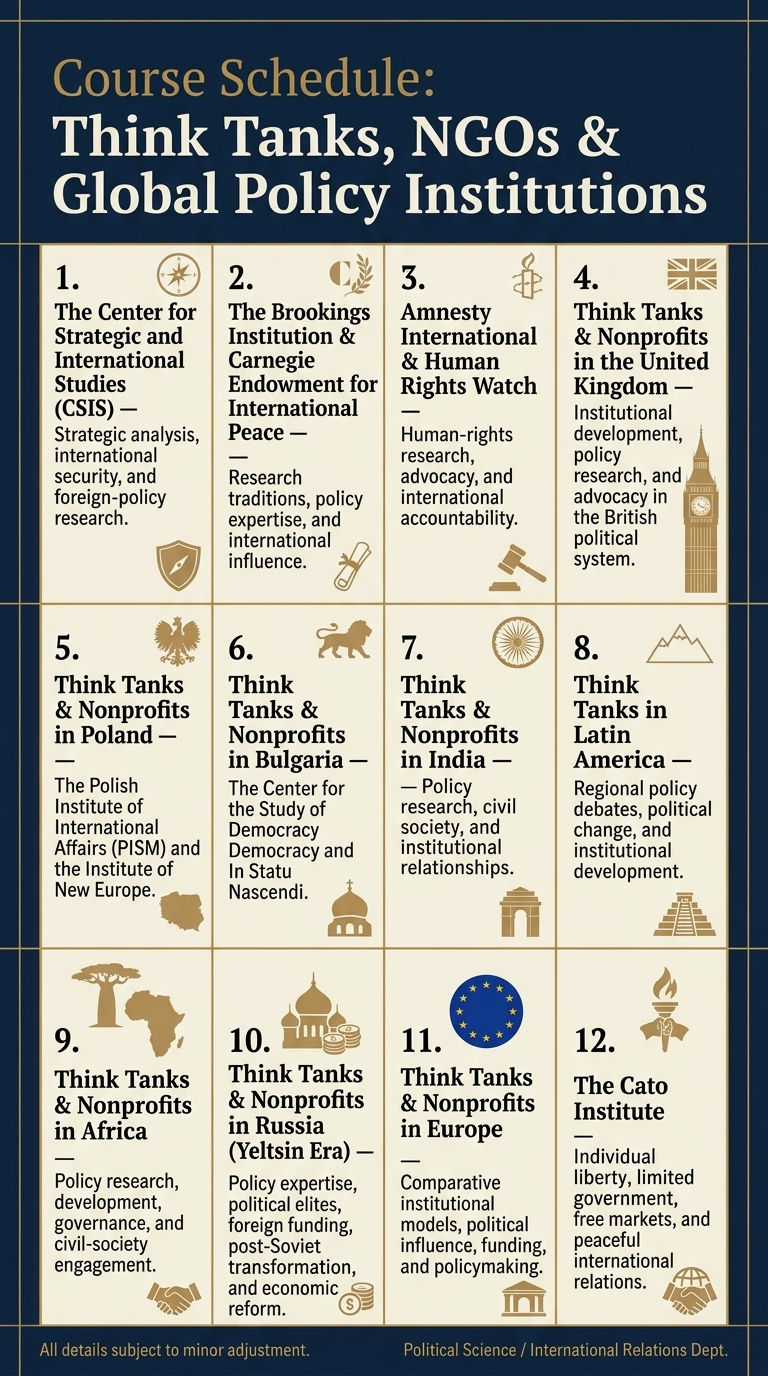
1. The Center for Strategic and International Studies (CSIS): Strategic analysis, international security, and foreign-policy research.
2. The Brookings Institution and the Carnegie Endowment for International Peace: Research traditions, policy expertise, and international influence.
3. Amnesty International and Human Rights Watch: Human-rights research, advocacy, and international accountability.
4. Think Tanks and Nonprofit Organizations in the United Kingdom: Institutional development, policy research, and advocacy in the British political system.
5. Think Tanks and Nonprofit Organizations in Poland: The Polish Institute of International Affairs (PISM) and the Institute of New Europe.
6. Think Tanks and Nonprofit Organizations in Bulgaria: The Center for the Study of Democracy and In Statu Nascendi.
7. Think Tanks and Nonprofit Organizations in India: Policy research, civil society, and institutional relationships.
8. Think Tanks in Latin America: Regional policy debates, political change, and institutional development.
9. Think Tanks and Nonprofit Organizations in Africa: Policy research, development, governance, and civil-society engagement.
10. The Emergence and Proliferation of Think Tanks and Nonprofit Organizations in Russia during the Yeltsin Era: The emergence of policy expertise, relationships between research institutes and political elites, foreign funding, post-Soviet institutional transformation, and the role of expert networks in economic reform.
11. Think Tanks and Nonprofit Organizations in Europe: Comparative perspectives on institutional models, political influence, funding, and policymaking across European countries.
12. The Cato Institute: Individual liberty, limited government, free markets, and peaceful international relations as foundations of libertarian policy research and advocacy.
For more information please visit:
https://www.instatunascendi.com/ngo
An ad hoc announcement
